
Independent Financial Research & Analysis
Daily briefings, 7,400+ real-time charts, and macro insights from Dr. Ed Yardeni and his research team.
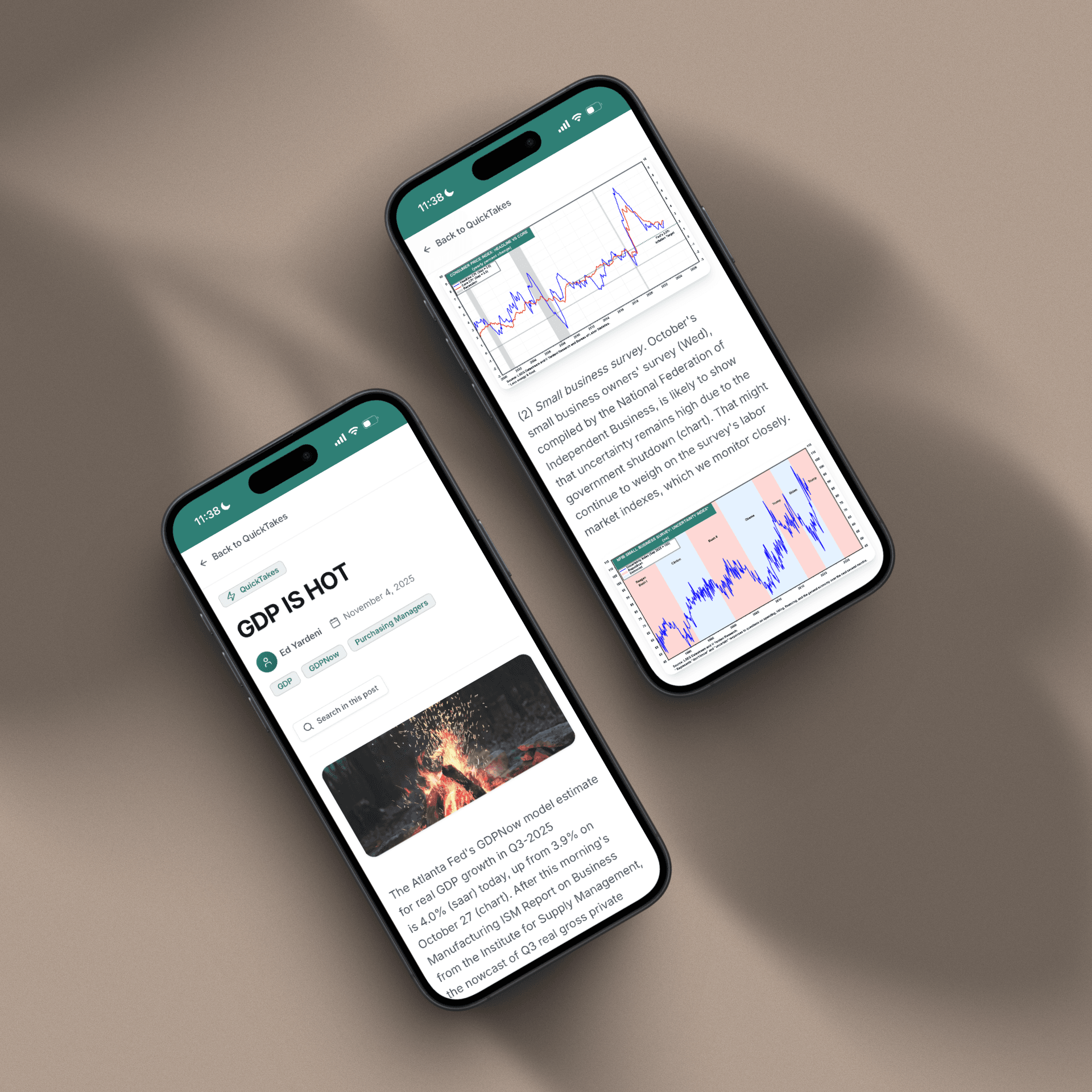
Research
Latest Research
Recent insights from our research team
Musk’s Lunar Economy, Data Centers & Industrials
Today, Jackie explores SpaceX’s extraterrestrial plans to build AI data centers in space, establish a lunar economy, and develop new trillion-dollar markets on the Moon, Mars, and beyond. Revolutionizing earthly travel with super-sonic aircraft is on the company’s to-do list as well. … Plus: Entrepreneurial upstarts and established companies alike also envision next-gen data centers operating in outer space, as well as the oceans. … And: The furious pace of AI data center construction has benefited the S&P Industrials sector this year; that and company restructurings have helped the index outperform ytd.
A Hawk In Dove's Clothing ... June Swoon Is Back ... 'We Have A Task Force On That'
We weren't surprised by most of the news following today's FOMC meeting. We expected the committee to pivot from April's easing bias to a tightening bias, and they did. We expected the committee to acknowledge that, in their dual mandate, the risk of higher inflation had risen, while the risk of higher unemployment had fallen, and they did. The FOMC's Summary of Economic Projections (SEP), including the Dot Plot, unambiguously confirmed the committee's hawkish pivot. We expected a June Swoon in the stock and bond markets because investors hadn't fully discounted our hawkish Fed scenario. The stock market swooned today as yields rose. The 2-year US Treasury note jumped to 4.20% today in response to the FOMC news (chart). On the other hand, we were blown away by Fed Chair Kevin Warsh's press conference. We thought he was a dove who favored lowering the federal funds rate (FFR) because he believes that AI is boosting productivity and economic growth while keeping a lid on inflation. Instead, he hammered home a strict, orthodox message on inflation with a strong commitment to price stability. Here are six key takeaways from June's FOMC meeting and Warsh's first press conference as Fed chair: (1) A more hawkish interest-rate outlook. In the June SEP, the median FFR projection for the end of 2026 increased from 3.4% in March to 3.8% (chart). The 2027 projection increased from 3.1% to 3.6%. The June Dot Plot pulled off a massive hawkish pivot compared to March. Over the rest of this year, nine meeting participants expect hikes: three expect one more, five expect two, and one expects three more (chart). Eight participants see rates remaining unchanged this year, while one still expects a cut. Warsh abstained, so there are 18 rather than 19 dots. (2) No more easing bias in the policy statement. In the FOMC's policy statement, the April language hinting at future rate cuts was replaced by a much shorter, blunter sentence committing to inflation control: "This Committee will deliver price stability." Warsh stripped the document down from over 300 words to a very brief 130 words. The text now narrowly outlines present economic facts (e.g., solid growth, energy-driven inflation) without any forward guidance. Nevertheless, the Dot Plot clearly reflects the hawkish shift we expected. (3) Acknowledgment of the economy's resilience. Warsh characterized economic growth as solid, broad-based, and supported by strong fundamentals, stating that “economic activity is expanding at a solid pace despite elevated uncertainty.” He said that “productivity growth and capital investment both [are] strong” and that “job gains have kept pace with the workforce.” He also emphasized that the labor market is “stable” and that “the jobs data has been moving in a good direction.” The SEP's projection for the unemployment rate at year-end was lowered from 4.4% in March to 4.3% (chart). It is projected to remain there in 2027. (4) Acknowledgment of persistent above-target inflation. Again, we were blown away by how often Warsh stressed that the FOMC's number-one goal was to bring inflation down to 2.0% y/y. He described inflation as persistently elevated, noting that it has been “running well ahead of the Fed’s … 2% [goal] … for more than five years” and said it “remains elevated … in part reflecting supply shocks.” While acknowledging uncertainty around inflation’s “first- and second‑round effects,” he stressed that the key risk is the prospect of inflation broadening. At the same time, he emphasized that inflation is controllable, arguing that it is “primarily determined by monetary policy” and that “inflation is a choice,” underscoring his view that any potential build‑up in inflation pressures reflects policy decisions rather than an embedded acceleration dynamic. The SEP projections for the core PCED inflation rate were raised from 2.7% to 3.3% this year and from 2.2% to 2.5% next year (chart). (5) The restrictiveness of the policy rate. Warsh suggested that the current policy stance is unevenly restrictive rather than uniformly tight. Overall, his remarks imply that the FFR is partially restrictive but not broadly so, with tightening effects concentrated in certain areas rather than the economy as a whole. The SEP shows that the "longer-run" (a.k.a. the neutral) FFR projection remained at 3.1%, in a 100bps range from 2.9% to 3.9% (chart). Warsh did not reveal whether he gives any credence to the concept of a neutral FFR. (6) Warsh aims to reform the Fed. Warsh announced that he is launching five task forces to overhaul key operational areas of the Fed: monetary policy frameworks, communications, regulatory scope, balance-sheet operations, and data and modernization. Warsh used the exact phrase "we have a task force on that" to deflect questions four times during his Q&A session. Whenever a reporter tried to pin him down on a specific market pain point, economic distortion, or policy prediction, he systematically dodged by pointing to his new five-panel security blanket.
On Hyperscalers’ Growth & China’s Persistent Deflation
The bigger the Big Four AI hyperscalers get, the harder it will be for them to keep up the same pace of revenue growth they’re enjoying today. But is AI such a disruptive game-changer that Amazon, Google, Meta, and Microsoft actually can keep growing and growing apace? Today, Melissa weighs the arguments on both sides of that question. The bullish case is solid, but there are risks to the bullish scenario. … Also: President Xi says China has defeated deflation, but May data tell a different story. William explains the festering problems causing prices to drop and why vanquishing deflation won’t be easy.
Archive
Our Research Library
19 years of daily research, charts, and analysis
Topics
QuickTakes Topics
Timely commentary covering the most important market themes
Charts
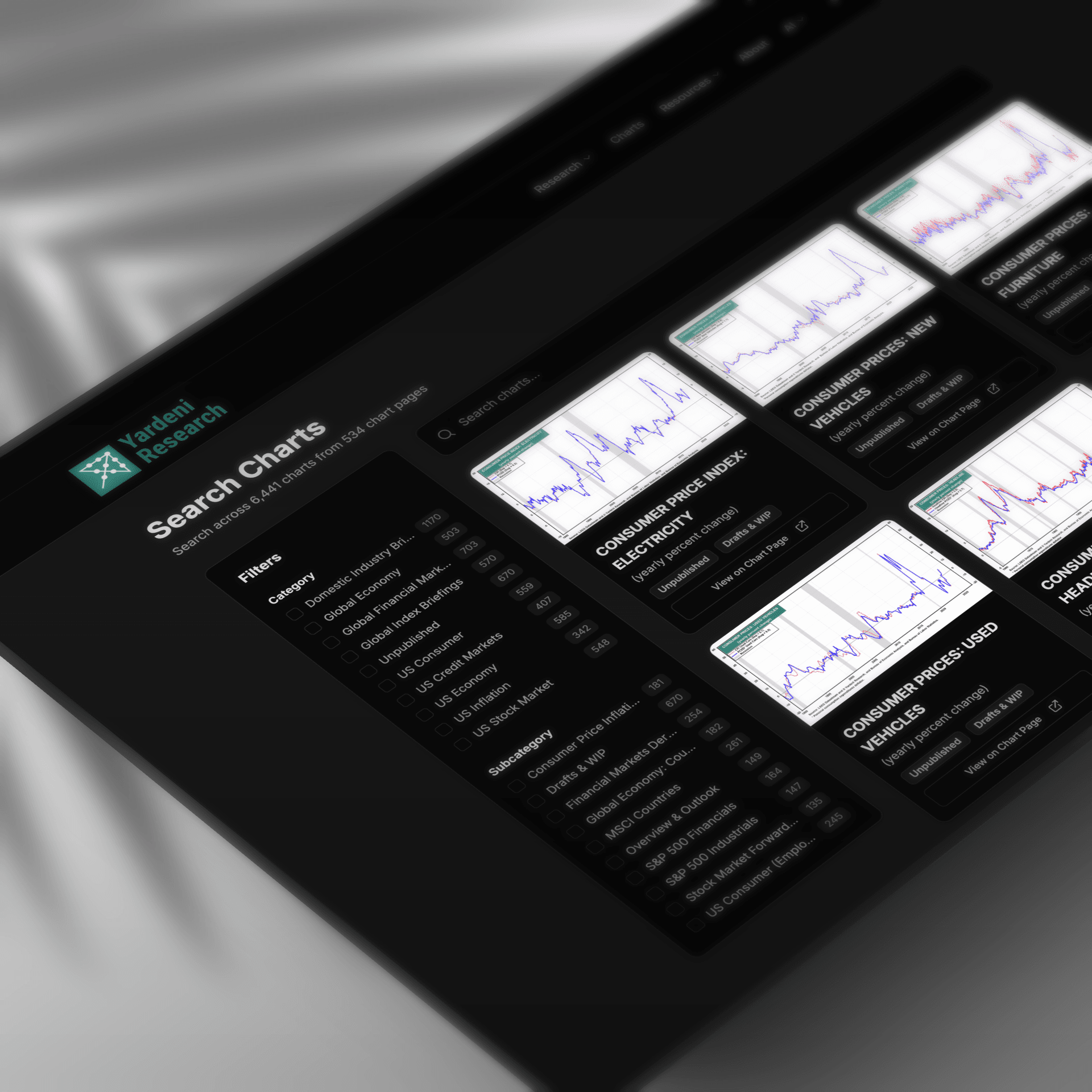
Find Any Chart in Seconds
Search across 7,409+ real-time charts with instant visual previews
ORACLE: STOCK PRICE (ORCL)
LOWE'S: STOCK PRICE (LOW)
WELLS FARGO: FORWARD P/E
LOWE'S: FORWARD LTEG, STRG & STEG
Sample charts from our collection of 7,409+ visualizations
Tools
Research Tools
Interactive dashboards for tracking economic conditions and market trends
Beige Book Monitor
Fed economic conditions across 12 districts with traffic-light signals.
FOMC Policy Meter
Dovish-to-hawkish policy stance tracker across FOMC meetings.
FOMC Minutes Monitor
Hawk/dove signal extraction across 10 economic themes.
FOMC SEP Monitor
Fed projections and dot plot distributions across meetings.
Private Credit Monitor
Auto-updating chronology of the private credit liquidity crisis.
Release Calendar
Major publications from the Fed, ECB, IMF, and 12 global institutions.
Try Yardeni Research free for four weeks.
Full access to everything we publish. No credit card, no obligation.